
India is a typically agrarian economy. With 157.35 million hectares under agriculture, India holds the second-largest agricultural land in the world. Additionally, India is among the fifteen leading exporters of agricultural products in the world.
With a rising population, globalization, a rapidly growing economy, and a surge of demand, it is no surprise that India stands to gain from increased foreign investments in the agriculture sector.
At present, 100% foreign direct investment (FDI) is allowed through the automatic route into India for the following agricultural activities:
- Floriculture, horticulture, apiculture, and cultivation of vegetables and mushrooms under controlled conditions
- Development and production of seeds and planting material
- Animal husbandry (including breeding of dogs), fish farming, aquaculture, under controlled conditions
- Services related to agriculture and its allied sectors
Other than these activities, foreign investments of up to 100% under the government route are permitted in the tea sector, including tea plantations.
Agriculture in India is a highly attractive sector. Besides the traditional opportunities, it presents numerous opportunities along its value chain to investors looking to invest in this lucrative sector. Some interesting areas are farm management services, agricultural inputs, logistics services (example: cold storage) amongst a host of others.
Land Acquisition
One of the major issues getting in the way of greater investments into the Indian agricultural sector is issues pertaining to land acquisition in the country. According to the master circular on acquisition and transfer of immovable property in India by NRIs/PIOs/ foreign nationals of Indian Origin circulated by the Reserve bank of India (RBI), foreign nationals of non - Indian origin do not hold permission to acquire any immovable property in the country. An exception from this rule is for property acquired through inheritance from an Indian resident.
Several states have their own laws regarding this issue and may have different guidelines to adhere to. States like Maharashtra and Karnataka only permit individuals to acquire agricultural land whereas, other states such as Delhi, Goa, Bihar, and Tamil Nadu permit both individuals and companies to acquire agricultural land for the purpose of carrying out agricultural activities.
It is also, however, important to note that the procedure for acquiring agricultural land differs from state to state. For example, the sale and purchase of agricultural land in the state of Maharashtra is governed by the Bombay Tenancy and Agricultural Lands Act 1948 (BTAL Act). The sale and purchase of agricultural land by a resident outside India is strictly prohibited.
Interestingly, any person residing outside of India carrying out activities in accordance with the Foreign Exchange Management Regulations 2016 can acquire immovable property provided they have established a branch, office or another place of business (excluding a Liaison Office) in India.
Contract Farming
The government of India, under the National Agricultural Policy, promotes private sector participation in the agricultural sector through the concept of contract farming and land leasing. This is to allow accelerated technology transfer, capital inflow, and assured market for crop production, especially that of oilseeds, cotton, and horticultural crops. This promotion of agri-tech has led to huge investments of over $10 mn in 2017.
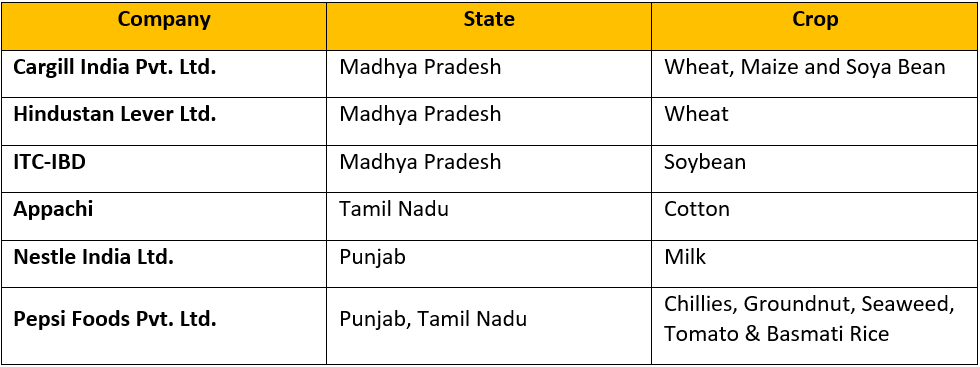
The table below lists some of the foreign companies practicing contract farming in India:
The Model Contract Act of 2018 was recently unveiled in order to protect the interests of the farmers. The act brings in all services in the agricultural value chain under its gambit including contract farming.
The traditional route of investment in agriculture is limited to the above-mentioned activities, which allow a 100% investment through an automatic route. However, India does not have a dearth of opportunities in its vast, diverse agricultural sector. The government of India is keen to promote FDI in agriculture for India while also protecting the interests of its domestic farmers and consumers.
Comments
Post a Comment